

AI visibility is not a sprint — it’s a race where the starting gun has already fired.
We help companies secure their position in AI search — strategically, technically and sustainably.
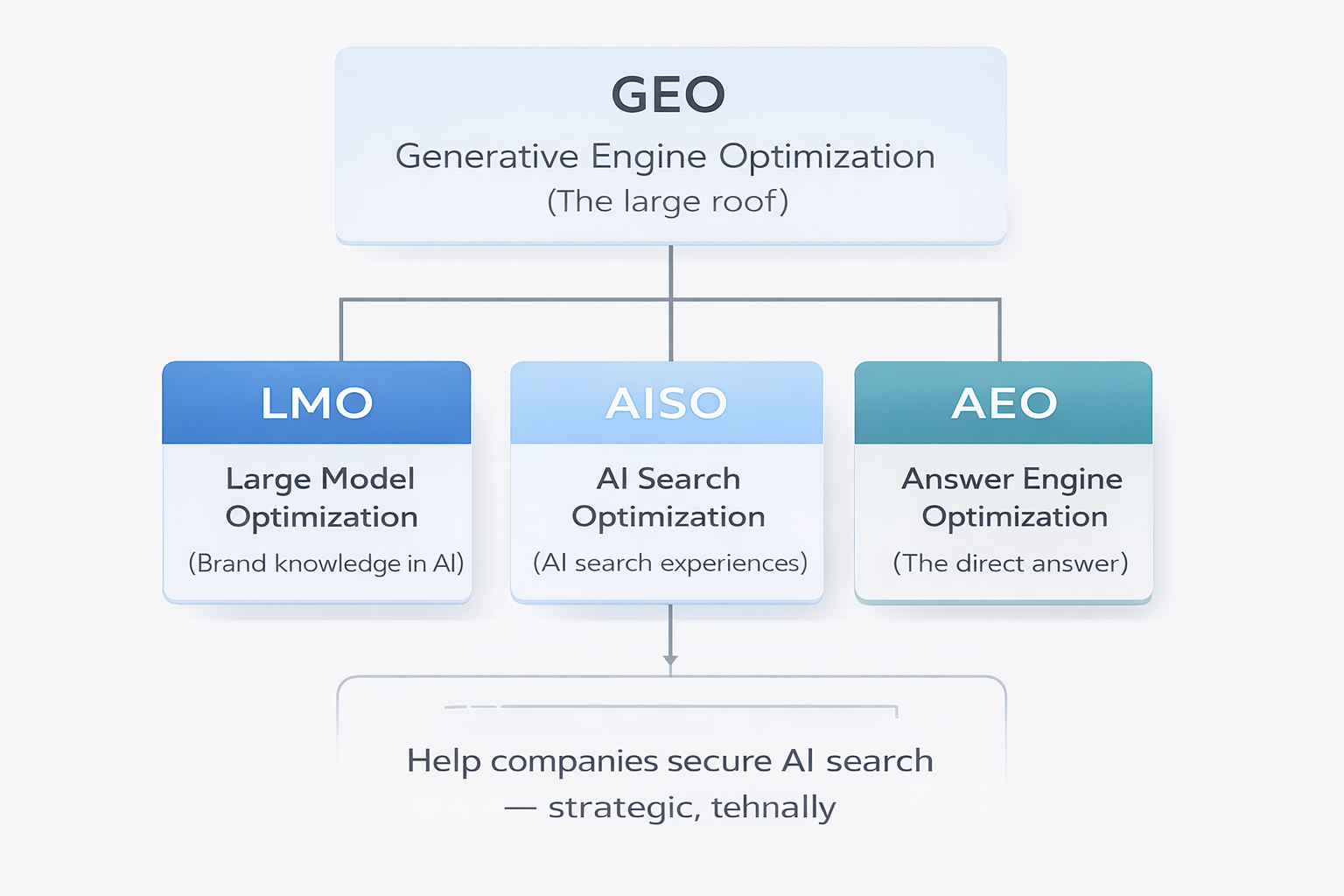
GEO – Generative Engine Optimization
What is GEO?
GEO describes the optimization of online content (websites, landing pages, online shops) for generative AI systems such as ChatGPT, Google AI Overviews, Perplexity or Copilot. The goal is to be present in AI-generated texts so that a company or a product is mentioned as a recommended solution in an AI answer, without the user carrying out a traditional search.
AEO – Answer Engine Optimization
What is AEO?
AEO is a sub-discipline of GEO. The focus is on optimizing concrete answers for AI and voice systems. The goal is for digital content to be recognized and cited as the best answer to a specific question. For example, if someone asks, “What is the best accounting software for SMEs?”, the aim is for one’s own brand to be mentioned as the answer.
AISO – AI Search Optimization
What is AISO?
AISO ensures visibility in AI-powered search interfaces, such as Google AI Mode or Bing Copilot. It combines technical SEO, content quality and AI readability. The goal is to appear as a recommendation or “search result” both in AI summaries and in supporting sources within the search experience.
LMO – Large Model Optimization
What is LMO?
LMO describes the optimization of a brand for large language models (LLMs) such as GPT, Gemini or Claude. LMO ensures that AI models are aware of a company or product and correctly assign it to an industry or area of expertise. The focus is on building long-term digital authority across many platforms.
GEO, AEO, AISO, LMO – What matters to participate in AI search
The rise of AI tools such as ChatGPT, Gemini, Copilot and others has led to the biggest change in search behavior since the introduction of mobile search. Studies¹ show around 10% of all users already use these AI tools for search – and the trend is rising – while also generating higher conversion rates. This does not replace classic search, but it changes how people research, compare and decide — especially in the early and mid stages of the customer journey. This new behavior leads to new terminology that describes how information (companies, products or services) is discovered and how it works within AI search. In short, these are:
-
GEO = Visibility in generative AI in general
-
AEO = Being named as the best answer
-
AISO = Visibility in AI-powered search
-
LMO = Building brand authority in large AI models
As a performance-oriented online marketing agency, Wolf + Bär primarily focuses its services on generating leads, sales and profits for its clients. For this reason, we have expanded our offering and can now also support our clients in AI search. How this works and what matters is explained in this blog article.
What matters when optimizing for AI systems?
Appearing in AI search results is the result of an interplay of many different factors. And it is not that far removed from “classic” search engine optimization (SEO) measures, nor does it replace them. Instead, it takes them to the next level. Where it used to be about pure keyword stuffing, today structure and content quality matter just as much – as does depth.
As systems become increasingly “intelligent,” they are now able to distinguish between high-quality texts and poorly written ones. Interestingly, AI-generated texts are even “penalized,” as AI systems can recognize their own language and infer that someone tried to take a shortcut simply to “polish up” a website or online shop. In other words, there is no way around putting in the effort to create authentic, unique and high-quality content. AI systems force quality.
How does AI search work?
AI systems require content in pure HTML source code rather than JavaScript-dependent content, server-side rendering for fast loading times, JSON-LD schema markup, semantic HTML5 elements, a logical header hierarchy, fast page load speeds, signals indicating content freshness, and access for AI crawlers such as CCBot.
In addition, they draw their knowledge from two primary information sources: pre-trained datasets from sources such as Common Crawl (62% of GPT-3 training data), Wikipedia or Reddit, as well as real-time retrieval via Retrieval-Augmented Generation (RAG), where current search results and external databases are used.
For websites, it is crucial to be set up correctly and to prepare data in a way that allows AI systems to find and process it in the first place.
Do users convert better from AI search than from classic search traffic?
Yes, companies can achieve higher conversion rates from AI search traffic. This is the result of various studies showing that conversion rates from AI search can be significantly higher compared to classic organic search.
This is not surprising, as a longer and more intensive research process precedes the result. On the one hand, users have already researched more thoroughly, and on the other hand, they are supported by AI systems throughout this process.
Looking purely at the numbers, other measures may generate more traffic, but traffic from AI search is far more valuable. This is partly due to Google expanding so-called AI Overviews: AI-generated summaries of search queries that appear before sponsored and organic results.
According to studies, when Google shows an AI Overview, users often get the answer immediately on Google, so fewer people click through to websites — organic CTR drops. Studies² report a range from -8% to -34.5% less clicks on links Google shows as search results. This has even led to a shift toward so-called “zero-click experiences,” which represents an entirely new phenomenon.
How can companies improve their AI visibility?
As mentioned, AI visibility depends on a wide range of factors. AI systems gather information from the entire web ecosystem. Websites play a central role, but signals are also taken from social media, forums, review platforms and more – many of which can only be partially influenced (owned).
Therefore, it is crucial to optimize everything that is within one’s own control – especially the company website. In addition to classic SEO measures, GEO for a website or online shop focuses particularly on content structure and quality.
For example, key messages should be placed within 160 characters, as Google’s AI Overviews specifically analyze these text blocks. In addition, content should be rich and high-quality in terms of context and semantics, making it easier for AI systems to process the information contained.
In short: AI visibility is not a departure from SEO, but the latest stage in the evolution of search. It combines SEO fundamentals with cross-channel optimization across all platforms from which AI systems source answers.
It is therefore not a sprint, but a marathon that requires patience and consistency. Improvements in AI visibility can take weeks or months. However, that does not mean there is plenty of time, because in AI search, second place means invisibility. While classic search displays multiple website options, AI search delivers a single consolidated answer – and this process is accelerating.
The window of opportunity for leadership in AI search is closing. Companies must act decisively now to secure their position in the AI-powered discovery ecosystem. Wolf + Bär stands by your side as a reliable partner in this process.
Where do I start?
AI visibility is not a sprint. It’s a race where the starting gun has already fired.
We help companies secure their position in AI search — strategically, technically and sustainably.
References
¹ Regarding increase search with AI
Pew Research Center (Artificial Intelligence topic page; U.S. adults): about one-in-ten U.S. adults say they get news sometimes or often from AI chatbots.
Gartner (Press release, Feb 19, 2024): predicts traditional search engine volume will drop 25% by 2026 due to AI chatbots and other virtual agents.
YouGov (Germany report “ChatGPT – Wer nutzt das Tool?”, 2025): reports broad awareness and usage; coverage cites about 43% of Germans having used ChatGPT.
⁴ (Optional) Procedia Computer Science (2019): research on switching search behavior from PC to mobile search.
² Regarding the trend towards zero-click-experiences
Ahrefs study (reported by eMarketer, Apr 18, 2025): “Google AI Overviews decrease CTRs by 34.5%.”
BrightEdge (press release / dataset, 2025): reported a nearly 30% reduction in click-throughs since May 2024 alongside rising impressions attributed to AI Overviews.
Pew Research Center findings (reported by Search Engine Land / 9to5Google / Ars Technica, 2025): searches with AI Overviews led to substantially fewer clicks to other websites (e.g., click rate reported dropping from ~15% to ~8% in coverage).