
Google Invited Me to Zurich. Finally, a Chance to Visit the Company I Pay Every Day.
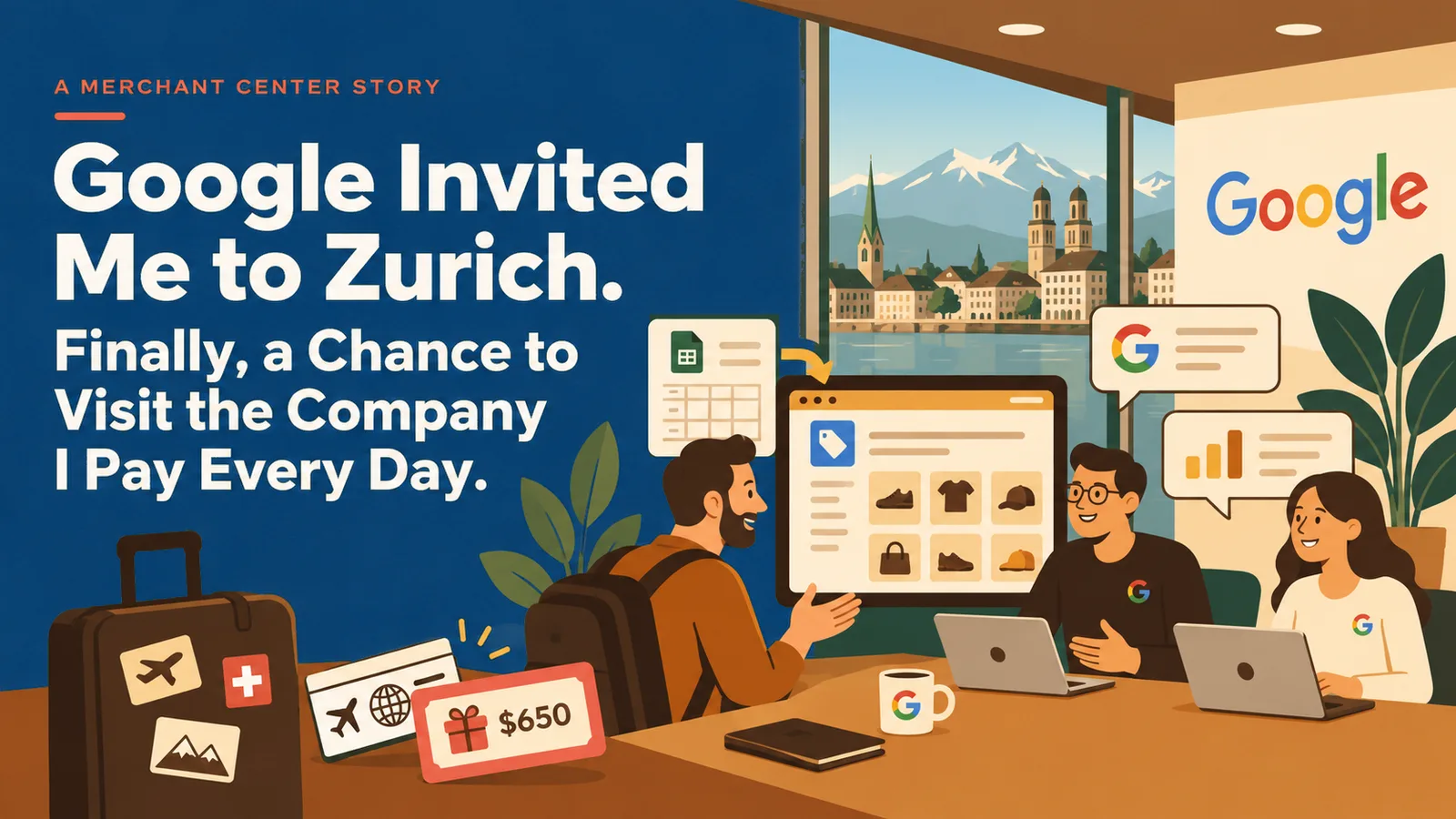
Google paid me $650 to talk about Merchant Center in Zurich. Why its tools are a small shop's weapons against big players, and what I asked Google to fix.
This article is also available in German.Read the German version
And for a change, Google paid me $650, plus travel expenses.
An unexpected invitation from Google
A few weeks ago, I received an invitation from Google to visit their offices in Zurich. They wanted to interview me about my experience with Google Merchant Center.
Besides working as Business Developer at Wolf+Bär, I also run Surfdeal.ch, a small Swiss watersports business with an online shop and a physical store. We're a seven-figure business, but certainly not a large company.
What makes Surfdeal interesting is that our webshop has over 100,000 SKUs, mostly connected through supplier integrations.
Together with Wolf+Bär, we've built Google Ads campaigns that give Surfdeal remarkable visibility in our niche. For certain product searches, we've even managed to achieve greater visibility than Galaxus, Switzerland's largest online retailer.
Apparently, my experience running this setup was interesting enough for Google to invite me to participate in a research session. And frankly, I was curious.
After all, I pay Google money every single day to advertise my products. Now they were offering me $650, plus travel expenses, to come to their office and talk about my business. For once, the money was flowing in the other direction.
How could I refuse?
A room full of Googlers
When I arrived at Google's Zurich office, I found myself in a room full of Google employees: people working on Merchant Center, some of whom had apparently flown in from different parts of the world.
They were just returning from lunch, slightly behind schedule. No problem. I'd taken the afternoon off anyway.
I also noticed a gentleman sitting towards the front of the room who turned out to be particularly interested in my answers. But before we got started, I felt I needed to make something clear.
"Guys, I'm the business owner. I'm not the technical guy."
And I meant it.
How I manage 100,000 products without being a technical expert
I explained how our business works. Every now and then, a Swiss watersports distributor calls me. They've noticed Surfdeal's visibility on Google and want to sell their products through our webshop.
My first question is always the same: "Sounds interesting. Do you have an API?"
Usually, one of two things happens. Either they ask: "What's an API?" Or they say: "Yes, we do."
If the answer is yes, I tell them to send me the details. And then? I give everything to Dennis. Dennis is our technical guy.
- The supplier sends the API details. I pass them on to Dennis.
- Dennis connects the data to our ERP. The supplier's products land in our ERP system.
- The ERP feeds Shopware 6. The products appear in our webshop.
- Shopware sends them to Merchant Center. From there, Google knows about every product.
- The campaign picks them up. When new products meet Google's advertising requirements, they can automatically enter our "catch 'em all" campaign.
At Wolf+Bär, we've set up that Google Ads campaign, which I like to call our "catch 'em all" campaign. The idea is simple: we don't have to create individual advertisements for thousands of products.
That's how we manage such a large catalogue with a relatively small team.
"How often do you check Merchant Center?"
Then came one of Google's questions: "How many times a week do you log into Merchant Center?"
My answer? "Zero."
Products in the webshop
100,000+
SKUs, mostly from supplier integrations
Merchant Center logins per week
0
My answer to Google's question
Merchant Center logins per year
About 2
Usually because something went wrong
I explained that I probably open Merchant Center twice a year. That seemed to surprise a few people. But from my perspective, Merchant Center is simply one small part of running my business.
At one point, someone suggested that Merchant Center probably represents less than 1% of my daily activities. Exactly.
I'm running a company. I have customers, suppliers, employees, stock, marketing, orders and a hundred other things to worry about. I don't want to spend my days studying Merchant Center dashboards.
I want the system to work.
Don't just tell me there's a problem. Fix it.
Google wanted to know what I actually look at when I do open Merchant Center. Usually, it's because something has gone wrong. Perhaps I've received a warning about a significant drop in active products.
I pass it on to Dennis. Dennis investigates and fixes the problem. Then I might log in, check whether the product overview looks healthy again, and move on.
Someone asked whether I ever investigate individual disapproved products. Sometimes. But when you have more than 100,000 products and perhaps 2,000 are disapproved, you tend to put things into perspective.
One common problem is that suppliers provide product images containing promotional text. Google doesn't allow certain text overlays on Shopping images, so those products can get disapproved.
My suggestion was simple:
Quote
Why doesn't Google's AI just remove the text and approve the image? Instead of telling me there's a problem, why not solve it?
Someone pointed out that Google already has an image improvement feature. This prompted a short discussion in the room about whether it could actually handle the situation I was describing.
Apparently, Google already has technology that can address at least part of this problem. Interesting. I hadn't known that.
And perhaps that's something worth thinking about as well. If a feature exists but business owners don't know about it, how useful is it?
My second suggestion: tell me when my feed stops updating
There was another issue I wanted to raise. Every night, Surfdeal sends updated product information to Merchant Center, including stock availability.
If that update doesn't arrive, Google may continue advertising products based on outdated information. That can mean wasted advertising spend and customers clicking on products that are no longer available.
At Wolf+Bär, we've solved part of this problem by setting up an external monitoring system. If an expected feed update doesn't happen, I receive an alert through Slack. Then I contact Dennis.
But I asked the Google team a simple question: why do we need to build this ourselves? Merchant Center knows when a feed was last updated.
Why not offer a setting where merchants can specify how frequently their feed should arrive and receive an email if an expected update is missed? For example:
Quote
My feed updates every night. If tomorrow morning's update hasn't arrived, please email me.
That would be genuinely useful. I didn't get a clear answer to that suggestion, but I hope someone made a note of it.
Give smaller merchants more weapons to compete
Towards the end of the conversation, I explained another part of my professional life. At Wolf+Bär, we help other e-commerce businesses grow through Google Ads and digital marketing. And when working with those businesses, I see Google's tools from a slightly different perspective.
I sometimes describe them as weapons that help smaller merchants compete against giants like Amazon. Think about:
- product ratings
- automated discounts
- local inventory ads
These tools give independent retailers opportunities that would otherwise be difficult to achieve. For a small merchant, competing with Amazon isn't easy. Amazon has enormous resources, technology and manpower. Independent merchants don't.
What they need are tools that make them more competitive without requiring an army of developers and marketing specialists.
This was the point I tried hardest to make clear in the meeting. The tools Google provides in Merchant Center are crucial weapons in my fight as a small online shop against big players like Galaxus. I simply don't have the same resources, so I need smart tools like Google's automated discounts and product ratings.
What makes them so valuable is that you set them up once, and then they more or less run by themselves. Every now and then something breaks and they need a push to get going again, but that's it.
What I took away from my afternoon at Google
I didn't leave Google's Zurich office with inside information about upcoming Merchant Center features. Nor do I know which of our suggestions will ever become reality.
But I did appreciate that Google had brought together specialists from different parts of the world to listen to the practical experiences of someone running a relatively small webshop.
For me, the afternoon also reinforced why my work at Surfdeal and Wolf+Bär fits together so well. At Surfdeal, I experience the daily challenges of running an e-commerce business. At Wolf+Bär, we help other businesses deal with many of those same challenges.
Things like unreliable stock information, product feed errors, advertising costs and competition from much larger retailers are familiar territory. And sometimes, even Google wants to hear about those experiences.
Thanks for the invitation, Google. It was a pleasure to finally visit the company I pay every day.